
April 12, 2026
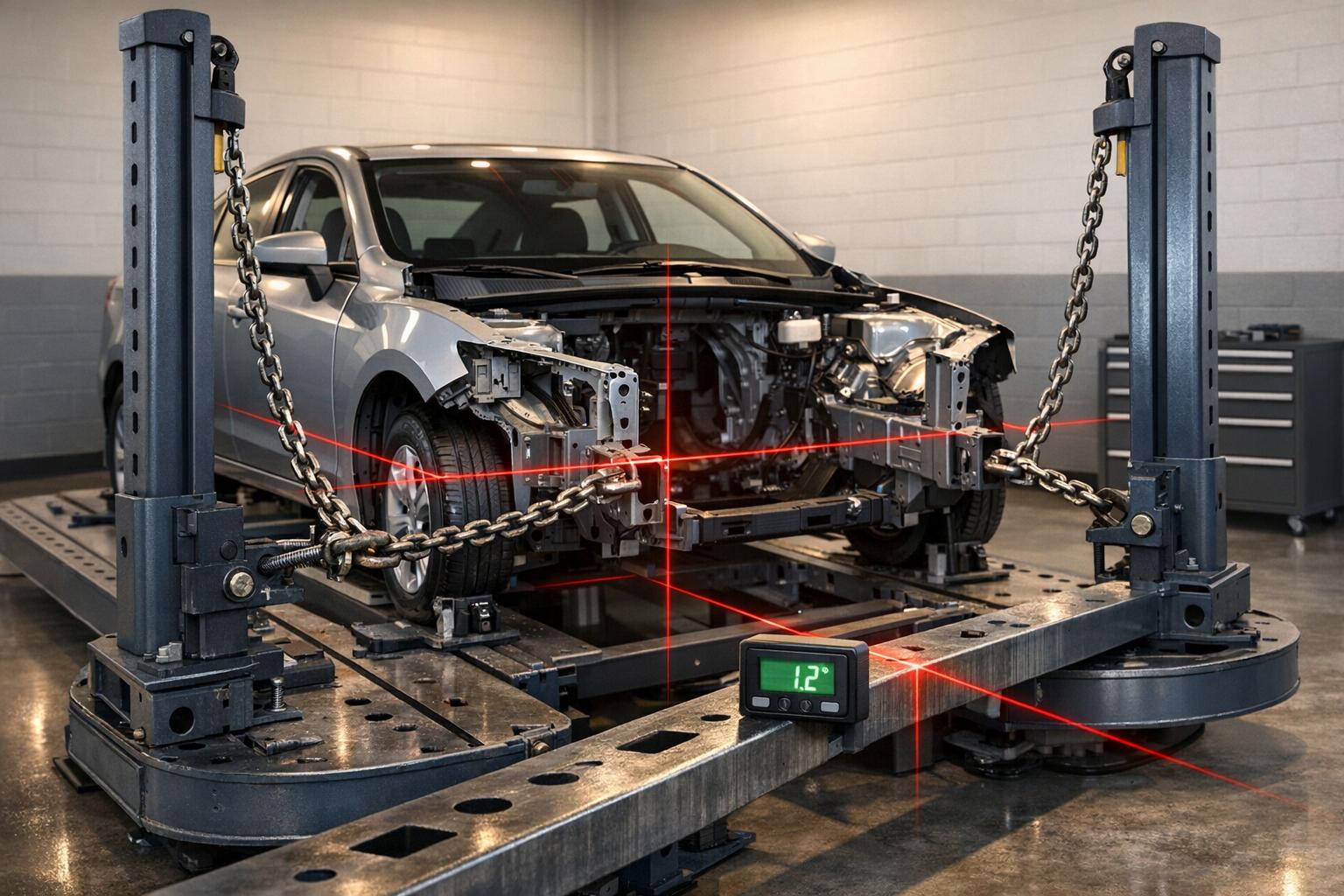
Your car's frame is its structural core. After a crash, frame damage can compromise safety, handling, and performance - even if it's not visible. Frame straightening restores the frame to its original factory specifications, ensuring safety systems like airbags and crumple zones function properly. Here's what you need to know:
Prompt repairs ensure your car remains safe, reliable, and roadworthy. If you suspect frame damage, professional inspection is critical.
When a vehicle is involved in a collision, its frame takes on the brunt of the impact, absorbing forces that can bend, twist, or compress the metal in ways that aren't always obvious. The nature of the damage depends on the type of crash. For instance, a head-on collision will stress the frame differently than a side-impact or a rollover. That’s why a thorough evaluation by an expert is crucial after any major accident.
The frame’s primary role is to absorb crash energy and protect passengers, which means it endures immense stress during a collision. Modern vehicles with unibody designs and older body-on-frame models react differently to these forces, creating unique damage patterns. Identifying these patterns is critical for determining the right repair method.
The type of collision directly influences how the frame deforms. In head-on or rear-end collisions, mashed frame damage is common. Here, the crumple zones - designed to absorb impact - get compressed, shortening part of the frame. This can compromise how the crumple zones function in future accidents, reducing their ability to protect the vehicle and passengers.
Twisted frame damage often occurs during side impacts or spin-outs, while sway damage happens when one side of the frame is pushed inward, causing horizontal misalignment. This is a typical result of side-impact collisions.
A sagging frame is a more severe issue, where the frame dips in the middle, signaling significant structural weakness. Another type, diamond frame damage, arises from corner impacts. In this case, the frame shifts out of alignment, so its corners no longer form right angles, disrupting the vehicle’s overall geometry.
"Proper automotive frame repair is essential to any collision repair as it being the main foundation for the structure of the car and its various alignments." - Chatsworth Auto Body
Your vehicle often gives subtle hints when its frame is damaged. For example, if your car pulls to one side or the steering wheel seems off-center, it could point to a misaligned frame.
Check your tires for uneven wear, such as bald spots or feathering, which may indicate that the suspension isn’t keeping the tires properly aligned with the road. Similarly, if the doors, hood, or trunk don’t close smoothly or show unusual gaps, it could mean the frame has shifted.
Other signs include creaking, clunking, or popping noises when turning or braking. A quick look underneath your car with a flashlight might reveal bent or warped frame rails or even fresh cracks. You might also notice fluid leaks, which can happen if frame damage misaligns engine or transmission mounts, putting stress on seals or fluid lines. Even misaligned bumpers, headlights, or body panels can signal hidden frame issues.
Ignoring these signs can lead to bigger problems, such as faster wear on your suspension and drivetrain, decreased fuel efficiency, and, most importantly, weakened safety features. A compromised frame might fail to protect passengers in another crash, and even critical systems like airbags could malfunction. These risks highlight why professional frame repairs are essential to restoring your vehicle’s safety and performance.

4-Step Frame Straightening Process: From Damage Assessment to Final Alignment
When frame damage is confirmed, technicians follow a detailed process to bring the vehicle back to its original specifications. Here's how each step ensures your car regains its structural strength and safety.
The process begins with a thorough visual inspection. Technicians look for signs like misaligned panels, doors that don’t close properly, metal creases, and uneven tire wear. Advanced tools like computerized laser scanners then come into play. These scanners measure key points on the chassis and compare them to the original specifications, detecting even the tiniest discrepancies - down to 1mm . They also check for hidden damage beyond the visible impact areas, including mechanical components and the vehicle’s structural framework. Using this information, they create a detailed repair plan, outlining the techniques and tools needed for the job.
The frame straightening machine is a robust platform equipped with rotating towers that can access various parts of the frame. To stabilize the vehicle, technicians use heavy-duty clamps to secure it firmly to the platform. With the car safely anchored, chains are attached to the damaged sections, connecting them to the machine’s towers. This setup ensures everything stays in place during the straightening process.
The real work begins as hydraulic towers apply controlled pressure to reshape the damaged frame. This process involves carefully calibrated, multi-angle force to prevent overloading the high-strength steel used in modern vehicles. Special attention is given to crumple zones - areas designed to absorb impact during a collision. Restoring these zones correctly is essential for maintaining the vehicle’s safety in future accidents . Technicians work in small, precise increments, constantly monitoring the frame’s progress as it returns to its original alignment.
Once the frame is straightened, technicians use advanced three-dimensional measurements to confirm it aligns perfectly with the manufacturer’s original specifications . Laser technology scans the entire frame to ensure everything is spot-on. If there are any lingering misalignments, the hydraulic towers are used for additional fine-tuning. The process wraps up with a series of safety checks, including test drives to verify proper handling and inspections of body panel gaps to ensure a seamless fit. These final touches prepare the vehicle for the next stage of repairs, ensuring everything is in perfect order.
Specialized tools and machinery are essential for precise frame straightening, ensuring proper alignment and restoring a vehicle's structural integrity. This process relies on a combination of sturdy platforms, advanced measurement tools, and heat application equipment.
The foundation of frame straightening is the frame straightening bench - a robust platform designed to securely hold the vehicle in place. These benches come equipped with multiple anchor points, allowing technicians to attach hydraulic pulling systems. These systems, fitted with 360-degree rotating towers and specialized clamps, apply controlled force from various angles. The hydraulic mechanisms generate the intense tension needed to realign heavy metal components.
To achieve pinpoint accuracy, laser measuring systems are employed. Tools like the Eclipse 3D, originally developed for aerospace applications, create detailed 3D maps of the vehicle's structure. These systems compare the vehicle's current dimensions to manufacturer specifications stored in a database of over 4,500 charts, identifying even the smallest deviations. Some setups also include Bluetooth-enabled tram gauges that sync with computer software, allowing real-time monitoring of the straightening process. Advanced computerized 3D measuring systems for damage analysis and repair verification are available, with prices starting around $4,499.
When dealing with particularly stubborn bends, heating equipment becomes crucial. Technicians use oxyacetylene torches or induction heating systems to soften the metal. Induction heating offers more precise and localized heat application compared to traditional torches, reducing the risk of damaging nearby components while making the metal more pliable for reshaping.
Once the frame is properly aligned, additional tools are used to reinforce and secure the repair. Welding machines, such as MIG (Metal Inert Gas) and TIG (Tungsten Inert Gas) welders, are employed to restore the frame's strength. The choice of welding method depends on the type and thickness of the vehicle's metal. After welding, technicians apply rust preventative coatings to exposed metal surfaces, protecting the frame from future corrosion and ensuring long-term durability.
If your vehicle has been in a significant collision, it's important to seek professional frame straightening right away - even if the damage appears minor. Some telltale signs of a shifted frame include misaligned doors, uneven gaps around the hood or trunk, pulling while driving, strange noises, or uneven tire wear. However, not all frame damage is visible, which is why advanced tools like computerized measuring systems are crucial for an accurate assessment. Addressing these issues early ensures your car gets the expert care it needs.
Your vehicle's frame isn't just structural - it acts as a safety barrier. That’s why certified technicians, often I-CAR Gold Certified, are trained to use advanced equipment and manufacturer-specific techniques to restore your frame to its original specifications. After evaluating the damage, they can give you a detailed repair timeline and cost estimate.
The time it takes to repair a frame depends on how severe the damage is. Minor adjustments might only take 1–2 days, while more standard repairs can stretch to 2–3 weeks. For complex jobs, like replacing sections of the frame, expect anywhere from 1–2 weeks or more. Factors such as insurance approvals, parts availability, and hidden damage can also impact these timelines.
As for costs, minor frame straightening typically ranges from $500 to $1,500, while extensive repairs can climb to $2,000–$10,000 or more. Most collision insurance policies cover these expenses, but if the repair costs exceed a certain percentage of your car's value, the insurer might declare it a total loss. While it’s natural to want your car back quickly, precision is key - proper alignment and recalibration of safety systems are non-negotiable.
Your vehicle's frame is its backbone - it safeguards you during a crash, ensures smooth handling, and supports all the essential mechanical components. Ignoring frame damage doesn’t just lead to issues like poor handling or uneven tire wear; it can also compromise critical safety systems designed to protect you and your passengers in an accident. Structural problems, even those hidden from plain sight, require precise measurement and attention.
As mentioned earlier, addressing frame damage promptly is key to maintaining both safety and performance. Professional frame straightening restores your vehicle to its original factory specifications, whether it involves minor tweaks or extensive repairs. Certified technicians ensure that vital systems like airbags, crumple zones, and overall structural integrity work exactly as intended by the manufacturer. This level of precision ensures your vehicle’s safety features are ready to perform when needed.
Delaying frame repairs can lead to a host of problems, including accelerated wear on suspension and drivetrain components, reduced fuel efficiency, and a significant hit to your vehicle’s resale value. More importantly, a weakened frame may fail to provide adequate protection in future collisions.
By restoring your frame to factory standards, you can drive with peace of mind, knowing your vehicle is reliable and safe. If you’ve been in an accident or suspect frame damage - whether it’s from misaligned doors, pulling while driving, or strange noises - Custom Collision in McMinnville and Smithville, TN, is ready to assist. Our ASE-certified technicians use advanced measuring systems and hydraulic frame machines to deliver precise, careful repairs. Plus, we work directly with your insurance provider and keep you updated throughout the entire process.
Reach out to us today for a professional inspection and let us help get your vehicle back on the road safely.
Driving with a bent or damaged frame is not safe. The frame serves as the vehicle's structural backbone, playing a critical role in safety and alignment. When the frame is bent, it can weaken the car's ability to absorb impact during a crash, disrupt proper alignment, and reduce protection for passengers. Continuing to drive in this condition can lead to unsafe handling, further structural damage, and a higher risk of injury. It's essential to have a professional inspect and repair the frame before getting back on the road.
Frame straightening plays a key role in preserving your car’s resale value. By restoring the vehicle’s structural integrity and ensuring its safety, you make it more attractive to potential buyers in the competitive used car market. These qualities are often top priorities for anyone shopping for a pre-owned vehicle.
If your vehicle’s frame needs straightening due to damage from a covered accident or collision, there’s a chance your insurance might cover the cost. Whether it’s included depends on the specifics of your policy and your insurer’s terms. To be sure, take a closer look at your policy or reach out to your insurance provider for clarification.
